









Trust is a rare commodity in the cryptocurrency space, and for good reason. Just when the market feels stable, a fresh scandal reminds us why "Don't Trust, Verify" is the only rule that matters. Thailand's digital asset community is currently digesting a harsh lesson in counterparty risk. Two high-profile insiders allegedly spun their industry clout into millions of dollars in stolen funds.
Enter Worawat Naknawdee, a flashy crypto pioneer, and Kampanat Vimolnoht, a supposedly well-connected venture capital analyst. Both men sold the ultimate crypto dream of exclusive access to life-changing wealth. Both, according to a growing mountain of police reports and furious investors, delivered nothing but ghosted messages and empty wallets.
Here is a breakdown of how the classic insider access grift played out in the Land of Smiles.
Part 1: "Acme Traderist" and the 500x Mirage
Worawat Naknawdee, known to his followers as "Acme Traderist", was not a newcomer. He built a legitimate reputation as a Bitcoin miner back in 2012, long before your local barista was asking about altcoins. Over a decade, he cultivated the ultimate crypto entrepreneur persona. He was the CEO of Bitnance, flaunted a luxury lifestyle, married an actress, and snapped photos hugging former prime minister Thaksin Shinawatra. Throw in a rumored stash of 8,000 BTC, an honorary finance doctorate from a Paris institution, and promotions of a $300 million UAE joint venture, and you have a walking, talking billboard for financial success.
But the real product Worawat was selling was FOMO.
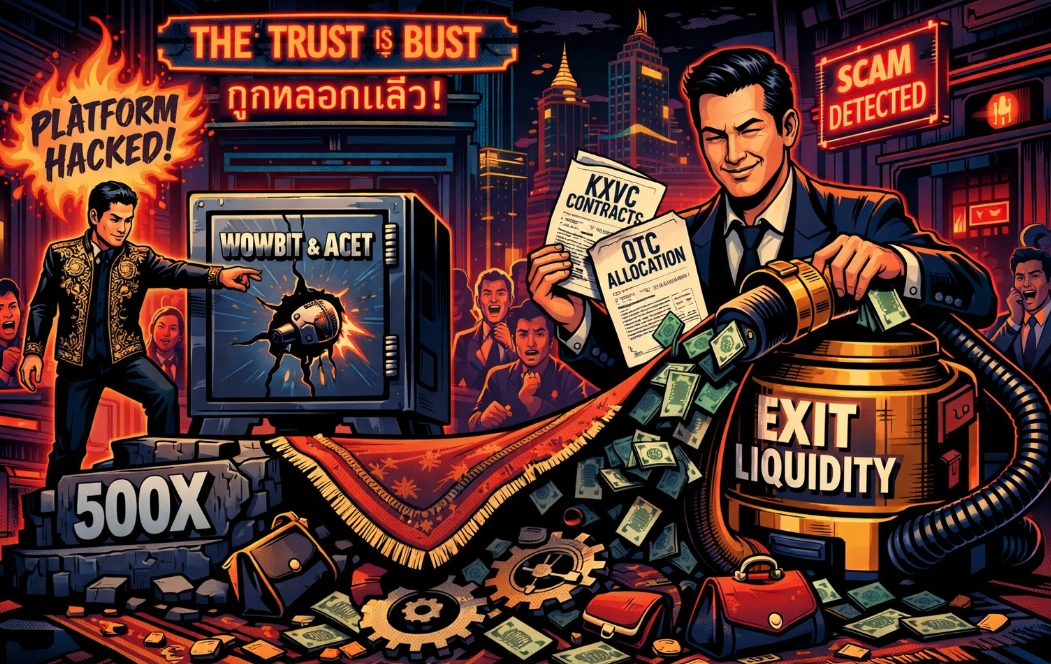
According to complaints filed with Thailand's Central Investigation Bureau, Worawat convinced investors to pour capital into two projects: WOWBiT and ACET ONLY. The hook was a guaranteed return of up to 500 times the original investment by March 1.
The Watchdog Insight: In the betting world, a tout selling "guaranteed locks" with 500-to-1 odds is an immediate, glaring red flag. The house always wins those bets. In decentralized finance, asymmetric returns do happen, but they are never guaranteed and certainly never promised on a fixed deadline. If someone guarantees you a 500x return, you are not the investor. You are the yield.
When March 1 rolled around, the funds were locked. Worawat cycled through the classic scammer playbook. First, he claimed the platform was hacked. When that failed to pacify the mob, he blamed nebulous foreign anti-money laundering regulations.
By the time 61 victims realized they had been played for roughly $2.35 million (a number police expect to climb), Worawat had already relocated to the United Arab Emirates. Interpol is currently warming up a Red Notice.
Part 2: The Fake VC and the Phantom Tokens
While Worawat used brute force influencer marketing, Kampanat Vimolnoht opted for a more sophisticated, institutional grift.
Kampanat was a former board director linked to KasikornX Venture Capital (KXVC), the Web3 investment arm of Kasikornbank. Armed with a UK master's degree in investment analysis and appearances at major events like the Singapore FinTech Festival, he looked every bit the legitimate venture capitalist.
He targeted a very specific, highly lucrative corner of the crypto market: early token allocations. Kampanat offered investors over-the-counter access to seed-round tokens for massive upcoming projects like Monad, Babylon, and Linera.
The Betting Context: Seed allocations are the holy grail for crypto speculators. It is the equivalent of placing a bet on a horse before the track has even opened to the public. You buy tokens at fractions of a cent before they hit public exchanges. However, these deals are highly restricted, usually requiring signed SAFTs (Simple Agreements for Future Tokens) and massive capital minimums. Retail investors almost never get a seat at this table unless a true insider sneaks them in.
Kampanat claimed to be that insider. He provided contracts bearing the KXVC name, lending massive institutional credibility to the scheme. Investors handed over anywhere from $20,000 to over $1 million each, waiting for the October vesting cliffs to unlock their digital gold.
When the release dates hit, Kampanat's excuses mirrored Worawat's. He blamed paperwork, market conditions, and bad partner projects. By November, he had vanished entirely.
The fallout was brutal. Subsequent investigations revealed that 19 different crypto projects had never heard of Kampanat. Worse, KXVC publicly stated he had left the firm months prior, noting that their corporate fund strictly invests its own capital and never raises money from external retail investors. The contracts were allegedly fabricated from scratch.
The Takeaway: Stop Buying the "Insider" Illusion
These two scandals highlight a glaring vulnerability in the crypto ecosystem. Despite the underlying technology being built on transparent, decentralized ledgers, retail investors are still too willing to hand over fiat to centralized figures in private Telegram or WhatsApp chats.
Whether it is a flashy millionaire promising a 500x return or a suited analyst offering backdoor access to tier-one VC deals, the mechanics of the scam remain identical. If an opportunity sounds too good to be true, it is not an opportunity. It is exit liquidity.