










Original reporting credit goes to the BBC for bringing the human element of these staggering thefts to light. We are breaking down the mechanics, the market reality, and how to avoid becoming a statistic.
Original reporting credit goes to the BBC for bringing the human element of these staggering thefts to light. We are breaking down the mechanics, the market reality, and how to avoid becoming a statistic.
There is a unique psychological torture reserved exclusively for cryptocurrency victims. In traditional finance, stolen money vanishes into a black hole of offshore accounts and shell companies. In crypto, your stolen funds sit in a glass vault on the blockchain. You can see your money. You can track it. You just cannot touch it.
Welcome to the harsh reality of digital self-custody.
Take "Helen and Richard," a UK couple featured in a recent BBC report. They spent seven years diligently stacking Cardano (ADA). They understood the market risks and the volatility inherent in betting on altcoins. They were prepared for market dips. They were not prepared for a silent, digital home invasion.
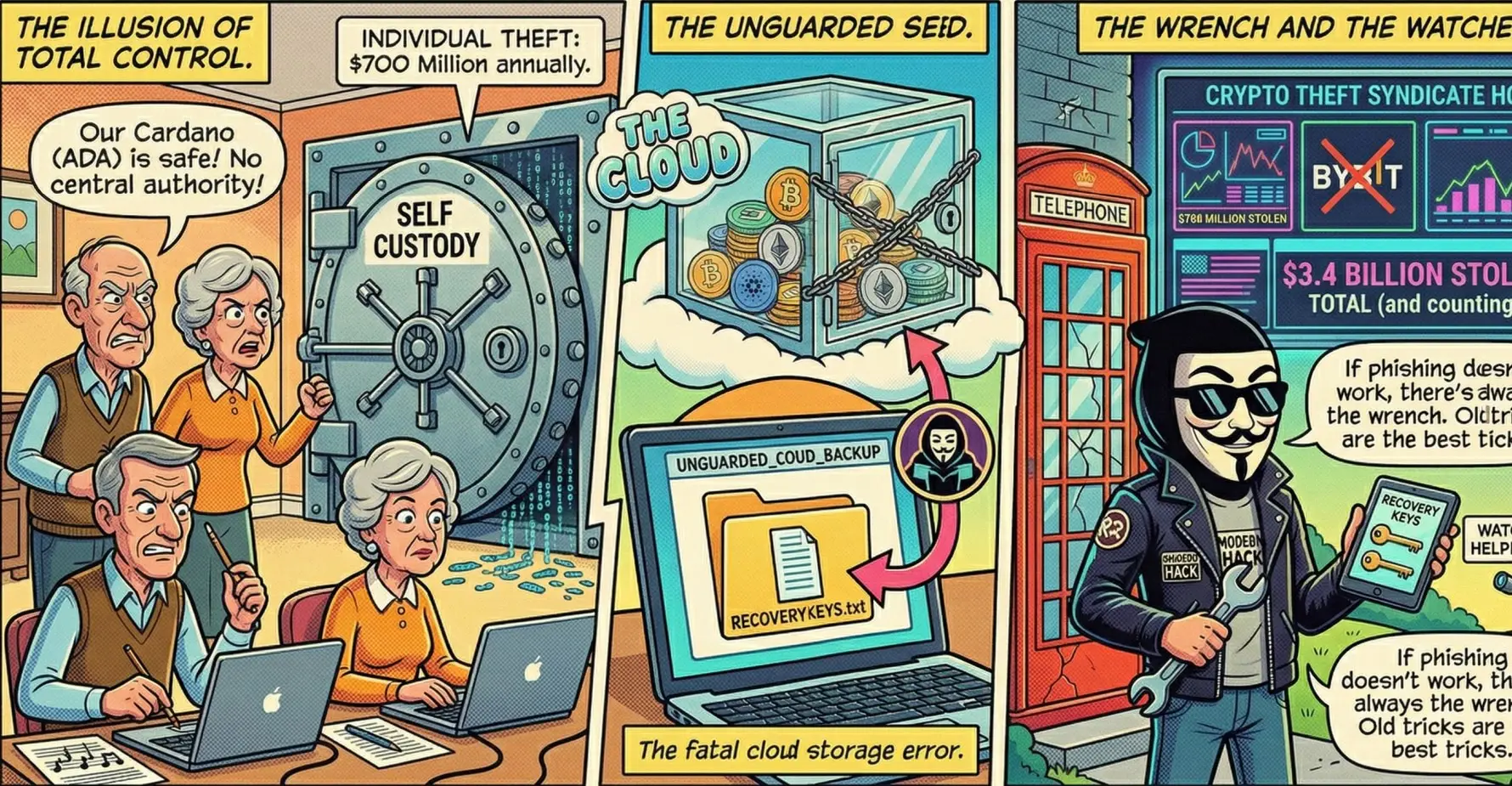
The couple kept the recovery information for their crypto wallets in a cloud storage account. To security veterans, this is the equivalent of taping the combination code to the front of a physical safe. Hackers breached the cloud, ran a small test transaction, and then drained $315,000 worth of ADA. The couple has spent months watching their life savings bounce between anonymous wallets.
While the empathy for victims of theft is genuine, the crypto arena is an unforgiving casino. If you leave your chips unguarded, the house, or in this case, the hackers, will take them.
The Bull Market Target on Your Back
According to Chainalysis, 2025 was a lucrative year for digital thieves, with over $3.4 billion siphoned from the ecosystem. While massive exchange hacks (like the $1.5 billion Bybit breach orchestrated by North Korean syndicates) make the headlines, retail investors are quietly bleeding out.
Individual attacks doubled from 40,000 in 2022 to 80,000 last year, accounting for roughly $713 million in stolen funds.
Why the spike? The math is simple. As the broader market cap swells and Bitcoin mints new millionaires, the incentive for targeted attacks skyrockets. In the high-stakes betting world of cryptocurrency, hackers are playing the probabilities. It is exponentially easier to phish a retail investor than it is to breach a multi-signature institutional cold wallet.
The Anatomy of Modern Crypto Theft
Criminals are no longer just guessing passwords. They are utilizing sophisticated social engineering and leveraging massive corporate data leaks.
Common Attack Vectors We Are Tracking:
- Cloud Seed Storage: The classic blunder. Taking a screenshot of a 24-word seed phrase and letting it sync to Apple iCloud or Google Drive.
- The VIP Target List: Hackers are purchasing stolen corporate databases to cross-reference with crypto users. A recent BBC interview highlighted a hacker who bought a customer database from luxury conglomerate Kering (Gucci, Balenciaga) for $300,000. The hacker used purchase histories to identify high-net-worth targets, successfully scamming over $1.5 million from Coinbase users.
- Phishing & Fake Airdrops: Malicious smart contracts disguised as free token claims. You sign the transaction, and your wallet is drained instantly.
From Digital Theft to 'Wrench Attacks'
The most alarming trend in the crypto underworld requires no code at all. The community calls them "wrench attacks," a nod to the crude but effective method of physically threatening a victim with a tool until they hand over their hardware wallet PIN.
We are seeing a disturbing migration of traditional organized crime into the crypto space. Why fence stolen Rolexes for pennies on the dollar when you can force someone to transfer a million dollars in Bitcoin from their smartphone?
The BBC noted several harrowing incidents across Europe, including home invasions, kidnappings, and highway robberies specifically targeting crypto holders. In France, the co-founder of security firm Ledger was abducted. In Spain, a botched extortion attempt ended in tragedy.
This brings us to a critical rule of crypto OPSEC (Operational Security). Do not flex. Bragging about your portfolio on X (formerly Twitter) or flashing luxury goods bought with crypto gains is effectively painting a target on your own back.
The Price of Absolute Freedom
The foundational ethos of cryptocurrency is "be your own bank." It is a powerful concept. You are insulated from arbitrary account freezes, bureaucratic red tape, and fractional reserve lending.
However, being your own bank means you are also your own security guard, your own fraud department, and your own armored transport. If you lose your keys, there is no customer service hotline to reset your password. If a hacker drains your self-custody wallet, there is no FDIC insurance to make you whole.
Innovators are trying to bridge this gap. Companies like Haven are developing wallets with continuous biometric checks, geofencing, and panic buttons. But technology can only do so much if human error remains the weakest link.
Helen and Richard lost everything by trusting a centralized cloud provider with decentralized keys. It is a devastating lesson, but one the rest of the market must learn from. Protect your keys, keep your wealth quiet, and remember that in the digital wild west, you are entirely on your own.