











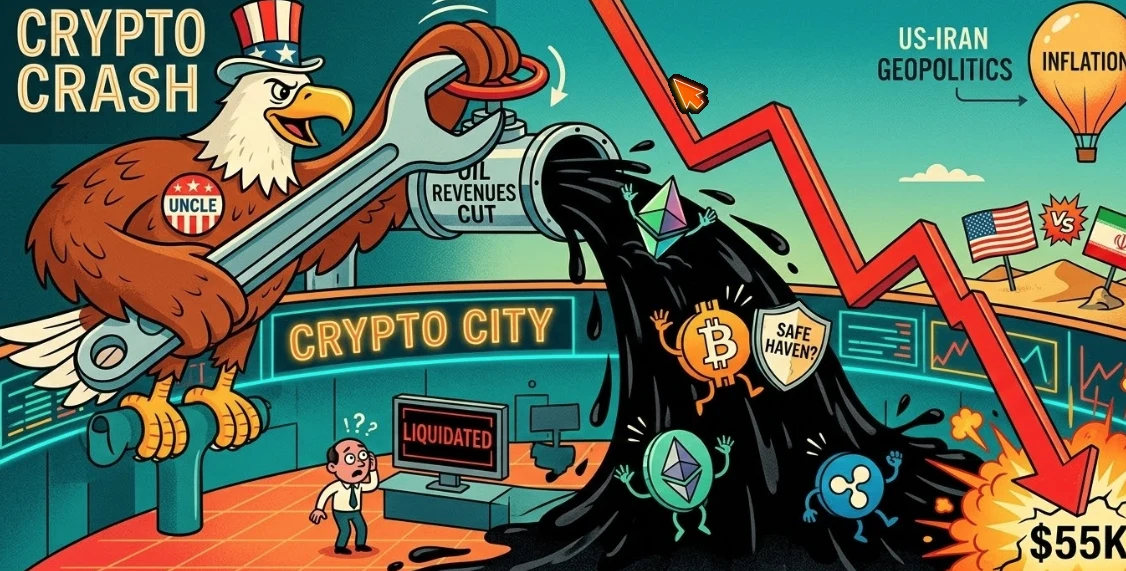
Welcome back to the reality check. If you woke up to a sea of red across your crypto tracker, you can stop blaming the algorithm. The market is currently reacting to something much heavier than a bad token unlock. The escalating military conflict between the United States and Iran has collided with the global economy, and high risk assets are taking the first massive hit.
The digital asset market does not exist in a vacuum. When traditional markets panic over surging oil prices and geopolitical instability, the crypto casino is usually the first place investors go to pull their chips off the table. Let us break down exactly why Bitcoin just erased its recent gains and what this means for your portfolio.
The Macro Backdrop: Oil Revenues and Unconditional Surrender
The immediate catalyst for this week's crypto crash is straightforward geopolitics. A White House official recently confirmed that the United States is actively seeking to cut off Iran's oil revenues, aiming to choke the financial supply to groups like the Islamic Revolutionary Guard Corps. Because oil is Iran's primary economic engine, threatening this supply chain instantly spooks global energy markets.
Adding fuel to the fire, Donald Trump took to Truth Social to declare that the US will not accept any deal short of unconditional surrender. Iranian President Masoud Pezeshkian fired back, explicitly stating that Iran would take that demand to the grave. When nuclear capable nations stop negotiating and start issuing ultimatums, institutional money runs for cover. The fear of a protracted, region wide war has driven oil prices sky high, sparking fears of stagflation. When the cost of energy spikes, inflation usually follows, which means central banks keep interest rates high. That is a toxic environment for risk assets like cryptocurrency.
The Myth of the Digital Safe Haven
For years, maximalists have pitched Bitcoin as "digital gold" and a safe haven asset during times of crisis. The events of March 2026 are providing a harsh reality check. While Bitcoin might be a hedge against long term fiat debasement, in the short term, it trades like a hyper volatile tech stock.
When war headlines break, investors experience a sudden need for cash. Because crypto markets operate 24/7 and are highly liquid, they are the easiest assets to sell at a moment's notice. On chain data reveals that short term holders recently moved roughly 27,000 Bitcoin to exchanges, accelerating the downward pressure as traders scrambled to lock in profits near the $68,000 mark before the geopolitical situation worsened.
The Chart Damage and the $55K Threat
The mathematical reality of this panic is grim. The total crypto market capitalization recently shed over $300 million in leveraged liquidations in a single day. Bitcoin violently rejected the $74,000 level and tumbled down roughly 4 percent, crashing through the $68,000 support zone.
Technical analysts are sounding the alarm. Prominent traders are pointing to a bearish flag pattern forming on the 8 hour Bitcoin chart. The price had been climbing inside a fragile, upward sloping channel following the initial drop. If spot selling volume breaks the lower support of this flag, it officially confirms a bearish continuation. The next major downside target in that scenario sits ominously near the $55,000 level.
The carnage is equally brutal in the altcoin trenches. Ethereum has slipped below the psychological $2,000 barrier, dropping nearly 5 percent. Ripple is hovering around $1.37, while major network tokens like Solana, Cardano, and Dogecoin have all bled out between 3 and 5 percent. When risk appetite dies, altcoins always bleed faster than Bitcoin.
The Betting Insight: Trading the Panic
If you are trying to navigate this market, you need to separate the headlines from the mechanics. Geopolitical shocks historically trigger an immediate 10 to 15 percent drawdown in risk assets as leveraged traders get forcefully liquidated. This is the market flushing out the weak hands.
However, historical data from previous Middle East escalations shows that markets often price in the absolute worst case scenario within the first two weeks of conflict. Once the initial shock wears off and the situation stabilizes into a new normal, risk assets typically find a floor.
If you are trading on high leverage right now, you are essentially gambling on military press briefings, which is a fantastic way to go broke. The smart money approach during a geopolitical flush is to patiently wait for the liquidations to cascade, let the volatility index cool down, and slowly accumulate blue chip assets at discounted prices. Let the panic sellers provide your entry liquidity.