








It seems like every day in 2018 brings a new blockchain project promising to revolutionize how we spend our digital assets. Enter ZantePay, an Estonian based fintech project pushing a cryptocurrency wallet and a prepaid card. Their big pitch is that users will be able to spend Bitcoin, Ethereum, Litecoin, and their native Zantecoin anywhere, seamlessly integrating with major payment networks like Mastercard.
Groundbreaking, right? Well, only if you have ignored the dozens of other startups promising the exact same crypto to fiat gateway this year.
Before committing any capital, it is crucial to look past the marketing hype and examine what is actually being offered.
The Problem of Originality
The core issue with ZantePay is a complete lack of originality. Offering a prepaid crypto card is a known concept in the current market, yet the execution and regulatory hurdles remain massive. Instead of presenting a novel technological breakthrough, perhaps similar to the rigorously peer reviewed work we see from teams like Cardano, ZantePay is simply echoing a tired narrative.
They are asking for a massive influx of capital for an idea that is already being tackled by established, well funded players. Ideas cannot be protected from replication, but a project demanding millions should at least bring a unique angle to the table.
Questionable Token Metrics
A quick glance at the paid ICO reviews dominating the space right now reveals a heavy focus on their token metrics, and this is where the financial reality becomes concerning.
Their Pre ICO is currently live, offering standard ERC20 tokens to investors. The breakdown of their 2 billion total token supply is highly skewed:
-
600 million tokens are available during the sale period ending July 15th, representing only 30% of the total supply.
-
600 million tokens are earmarked exclusively for marketing expenses.
-
800 million tokens are reserved for development and the team.
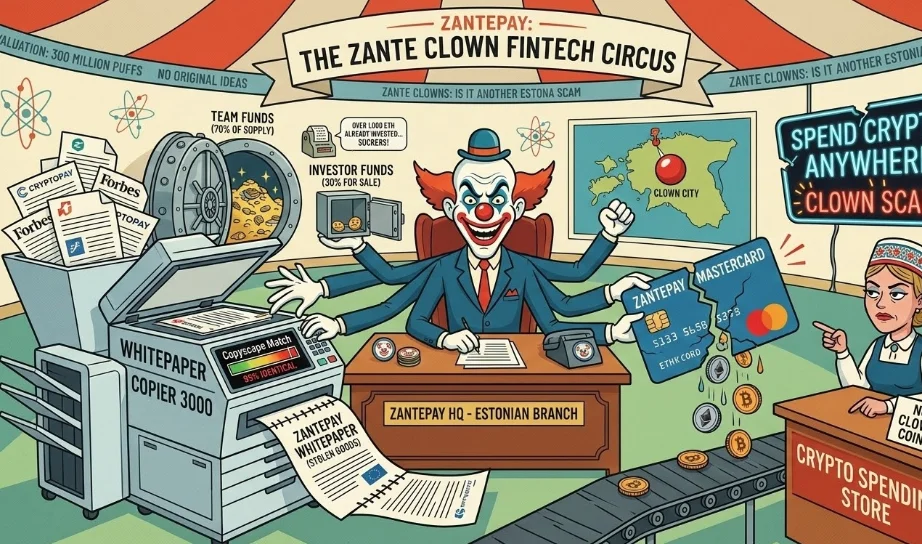
Doing the math, this implies a post ICO valuation hovering around the $300 million mark. A valuation of this magnitude for a project with no unique intellectual property, where the founders and internal reserves retain 70% of the supply, is highly disproportionate. It is a prime example of the current ICO bubble where speculative funding drastically outpaces actual utility. Astonishingly, as of this writing, over 1,000 ETH has already been poured into the project.
The Copyscape Revelation
As someone who manages digital content, running text through Copyscape is a standard operating procedure to ensure originality. Usually, a few flagged quotes are expected. However, running the ZantePay whitepaper through the software yielded an absolute avalanche of warnings.
Excluding the matches that circle back to their own website, the results are quite revealing about the project's foundation.
Right out of the gate, they lifted a complete paragraph from a Forbes article written by Chance Barnett. The text discussing how ICOs raised nearly $2.3 billion in the first half of 2017 is copied word for word, with zero attribution.
It gets worse. They blatantly copy pasted legal and operational phrasing from a direct competitor. Cryptopay's whitepaper states:
"The Distributor considers this as a testament to the fact that Cryptopay wants to be transparent and inclusive for the community at large, which Cryptopay perceives as its most valuable asset."
ZantePay's version? They simply swapped out the word "Cryptopay" for "ZANTEPAY". The surrounding text and the entire structure are identical.
The Copyscape report reveals their whitepaper is essentially a patchwork quilt of other companies' work. They pulled risk disclosure statements from corporate presentations like Talbot Underwriting and Verisk Analytics, and lifted standard blockchain explanations from random Medium articles and other whitepapers like MoonRunner and Vital Coin.
Where From Here?
A whitepaper is supposed to be the foundational document of a tech startup, outlining a unique vision and technical architecture. When a project's primary document is a Frankenstein monster assembled from other peoples' work, it speaks volumes about their internal capabilities and dedication. I spent 39 cents on that Copyscape search, and honestly, it felt like an overpayment given the lack of original thought uncovered. Investors should tread very carefully.