











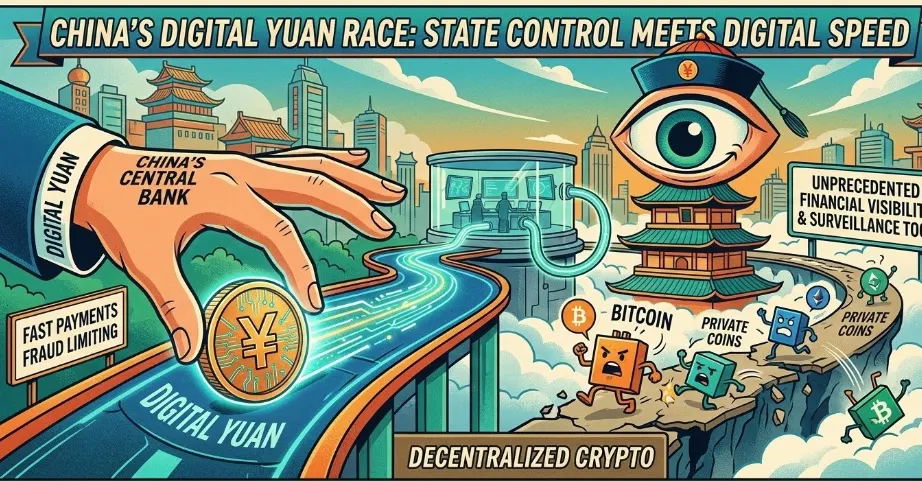
China has spent years studying digital currencies while maintaining one of the strictest stances against decentralized cryptocurrencies in the world. That strategy reached a new stage when officials from the People’s Bank of China confirmed that the country’s central bank digital currency was essentially ready for deployment. While the announcement did not include a precise launch date, it signaled that Beijing was serious about bringing a state-controlled digital yuan into circulation.
The project reflects a broader shift taking place among governments around the world. Central banks have watched the rapid growth of Bitcoin and other cryptocurrencies with both curiosity and concern. On one hand the underlying technology offers faster payments and modern financial infrastructure. On the other hand decentralized networks operate beyond the direct control of monetary authorities. For governments accustomed to managing currency flows, that loss of control is uncomfortable.
China’s approach attempts to capture the benefits of digital money while preserving the oversight of a traditional central bank. The digital yuan is designed as a two-tier system. The People’s Bank of China will issue the currency, while commercial banks distribute it to businesses and consumers. From the outside the wallet system may resemble a cryptocurrency interface, but behind the scenes every transaction remains visible to the state.
Officials argue that the system will modernize the financial system by reducing transaction costs, improving payment speed, and limiting fraud. Critics point out that it also creates a powerful surveillance tool. Digital cash that can be monitored, tracked, and potentially restricted offers governments an unprecedented level of financial visibility.
Timing also matters. China accelerated work on the digital yuan during the period when Facebook announced its Libra project. Libra threatened to introduce a global private currency backed by major technology companies. Chinese policymakers worried that such systems could strengthen the dominance of the U.S. dollar and weaken national monetary control.
By moving first with a large-scale central bank digital currency, China hopes to shape the future of digital payments on its own terms. Whether the rest of the world embraces similar systems remains an open question. What is clear is that the race to define the next generation of money has already begun.