









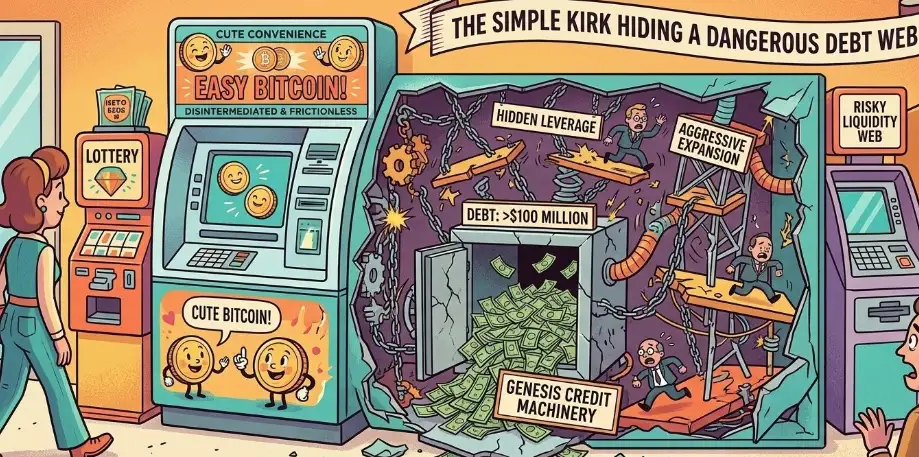
When a crypto ATM operator goes bankrupt while owing Genesis more than one hundred million dollars, it tells you two things immediately. First, the digital asset industry still has a remarkable capacity for building leverage into businesses that market themselves as futuristic convenience. Second, the humble crypto ATM is no longer just a quirky retail machine sitting in a corner next to the lottery tickets. In some cases it had become part of a much larger and riskier credit structure behind the scenes.
To the average user, a crypto ATM looks simple enough. Insert cash, receive Bitcoin, pay a chunky fee, and leave feeling vaguely cyberpunk. But scaling that model into a serious business often requires inventory management, liquidity access, compliance systems, physical operations, and financing. Once lenders and institutional counterparties enter the picture, the cute little machine starts depending on capital structures that are much less cute.
The Genesis angle mattered because Genesis was deeply entwined with the broader credit machinery of the crypto industry, especially before the sector’s lending collapses began exposing how much balance-sheet acrobatics was hiding under the surface. If an ATM operator owed that kind of money, it suggested aggressive expansion, heavy borrowing, or both. Neither is inherently fatal in a functioning market. In crypto, where volatility can erase assumptions faster than management presentations can update them, it is another story.
The bankruptcy also illustrated how interconnected supposedly ordinary crypto businesses had become. A failure in one corner, say lending, could quickly damage firms in another, like retail exchange infrastructure. This is the opposite of the simplified story many users told themselves, namely that buying and selling digital assets through consumer-facing products existed in a neat little box. In reality, plenty of these businesses were plugged into the same risky liquidity web that later unraveled across the industry.
What looked like a story about ATM kiosks was really a story about hidden dependency. Crypto loves presenting itself as disintermediated and frictionless. Then a bankruptcy filing arrives and everyone rediscovers the chains of credit, leverage, and counterparty exposure linking the whole machine together. The lesson is not that ATMs are uniquely dangerous. It is that in crypto, even the apparently boring businesses can be standing on top of a surprisingly adventurous pile of debt.