










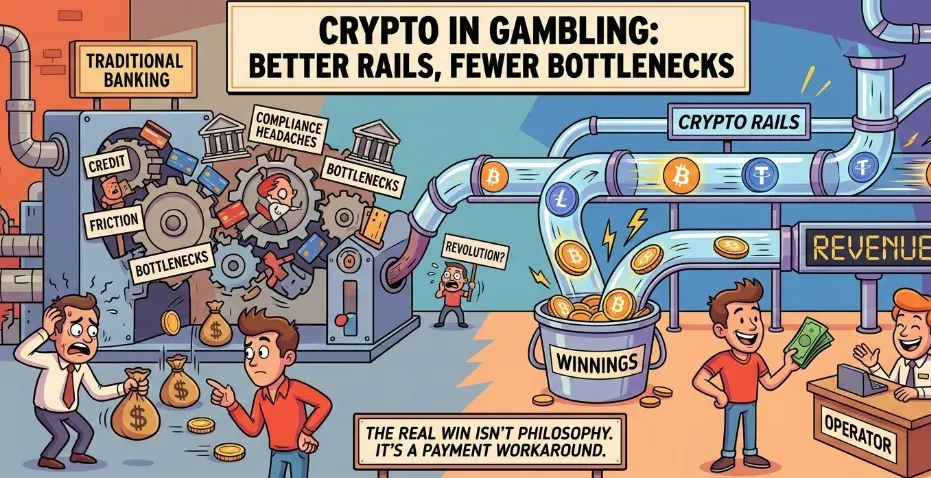
Cryptocurrency really did change online gambling, but not always in the embarrassingly breathless way affiliate pages liked to pretend. The real shift was less about digital utopia and more about payments. Gambling operators have always lived with friction from banks, card processors, cross-border compliance headaches, and the occasional financial institution that suddenly decides your perfectly profitable customer segment has become morally inconvenient. Crypto offered a workaround, and the industry noticed immediately.
For players, the attraction was speed and flexibility. Deposits could move quickly, withdrawals could clear far faster than traditional card rails, and users in awkward banking jurisdictions gained access to platforms that would otherwise be difficult or expensive to use. For operators, the logic was even clearer. Lower payment friction tends to increase activity, and increased activity tends to increase revenue. Nobody in gambling needed a philosophical lecture about decentralization to understand that.
There were also cultural reasons the overlap made sense. Online gambling and crypto share a certain appetite for risk, velocity, and international participation. Both sectors grew on the internet before regulators fully understood how large they could become. Both attracted communities comfortable with digital accounts, pseudonymous behavior, and moving money through systems that felt more native to the web than to conventional banking. Once those worlds intersected, the fit was almost embarrassingly obvious.
That said, not every “crypto casino revolution” deserved the label. Plenty of operators simply added Bitcoin or stablecoin deposits to old platforms and called it innovation. That is not worthless, but it is also not a civilizational breakthrough. The more meaningful changes came where crypto improved settlement speed, widened access, reduced dependency on unreliable payment intermediaries, or enabled provably fair mechanics that gave players at least some reason to trust the math more than the marketing.
The sector still carried all the usual baggage, naturally. Offshore risk, weak licensing, bonus traps, sketchy operators, and users who confuse fast bookmaker withdrawals with sound judgment. Crypto did not clean up gambling’s moral complexion. It made parts of the machinery run more efficiently. In practical terms, that was enough to matter. The online casino world did not need saving. It needed better rails, fewer banking bottlenecks, and customers willing to click deposit. Crypto delivered that. The rest, as ever, remained a question of who was actually running the table.